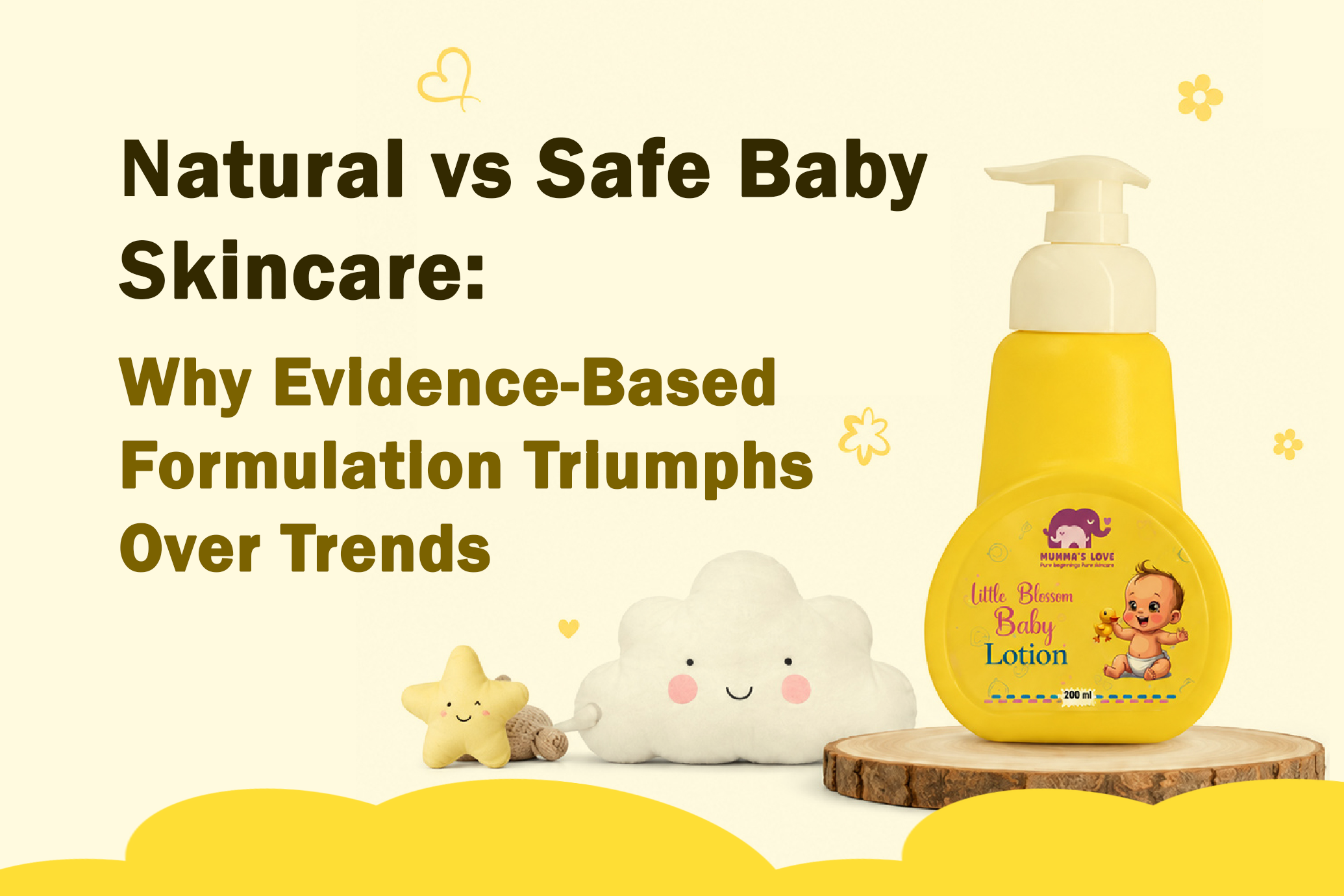
Natural vs Safe Baby Skincare: Why Evidence-Based Formulation Triumphs Over Trends
The Illusion of ‘100% Natural’ in Infant Care
When curating a nursery, the modern parent is bombarded with products boasting ‘100% natural’ or ‘organic’ labels. It is an intuitive leap to assume that what comes directly from nature is inherently safer for a newborn’s delicate physiology. However, in the rigorous field of pediatric dermatology, this assumption is not just flawed—it can be dangerous. The newborn epidermal barrier is profoundly different from adult skin. It is approximately 30% thinner, characterized by a highly permeable stratum corneum, and lacks the fully developed lipid matrix that provides structural integrity. When we apply unrefined natural ingredients to this fragile interface, we expose infants to complex botanical compounds that their immune systems are not yet equipped to process. Natural does not equal biocompatible.Consider the widespread use of essential oils in ‘natural’ baby products. Lavender, citrus, and eucalyptus oils are celebrated for their aromas, but at a molecular level, they are composed of hundreds of distinct volatile organic compounds (VOCs). Ingredients like limonene and linalool are well-documented contact allergens. When these compounds oxidize upon exposure to air, their allergenic potential exponentially increases. For a newborn whose immune system is still naive, these botanical extracts can act as haptens—small molecules that trigger an inflammatory cascade leading to allergic contact dermatitis. The evidence-based approach recognizes that while nature provides powerful healing properties, these elements must be clinically refined, standardized, and stripped of their irritant potential before they are safe for pediatric use.Furthermore, ‘natural’ products often lack robust preservative systems. The fear of synthetic preservatives has led to the rise of preservative-free or naturally-preserved formulations. However, the water content in baby lotions and washes creates the perfect breeding ground for pathogenic bacteria and fungi. A contaminated product poses a far greater risk to a neonate than a clinically proven, safe synthetic preservative. We must look past the marketing appeal of the word ‘natural’ and scrutinize the actual biochemical interaction between the product and the infant’s skin.This is where Evidence-Based Skincare becomes non-negotiable. At Mumma’s Love, our formulations are not dictated by agricultural trends but by dermatological science. We utilize biomimetic ingredients—compounds that mimic the natural lipids and humectants already present in healthy skin, such as ceramides and hyaluronic acid. By choosing science over slogans, we provide skincare that genuinely supports, rather than stresses, the developing acid mantle.
Understanding the Acid Mantle and Skin Biome
To truly grasp why safe beats natural, one must understand the biology of the infant ‘acid mantle.’ At birth, a baby’s skin pH is relatively neutral (around 6.5 to 7.0), largely due to the amniotic fluid. Over the first few weeks of life, the skin undergoes a critical acidification process, dropping to an optimal pH of 5.0 to 5.5. This slightly acidic environment is essential for two reasons: it inhibits the colonization of pathogenic bacteria like Staphylococcus aureus, and it optimizes the function of epidermal enzymes responsible for synthesizing barrier lipids.Many ‘all-natural’ soaps, particularly those made from saponified oils (traditional lye soap), are inherently alkaline, with a pH ranging from 9 to 11. Washing a baby with a natural alkaline soap forcefully strips the acid mantle, elevating the skin’s pH. This disruption not only invites bacterial overgrowth but also paralyzes the enzymes needed to repair the skin barrier. The result is transepidermal water loss (TEWL), leading to dry, flaky, and highly reactive skin. A product can be 100% natural and completely devastating to infant skin biology.Evidence-based formulations prioritize pH optimization above all else. A scientifically formulated cleanser utilizes ultra-mild synthetic detergents (syndets) that cleanse effectively while maintaining a strict pH of 5.5. This allows the cleanser to remove soil and irritants without compromising the structural integrity of the stratum corneum. It is a precise biochemical intervention that respects the skin’s natural developmental trajectory.Moreover, the infant skin microbiome is seeded during and immediately after birth. This delicate ecosystem of commensal flora relies on an undisturbed, pH-balanced environment to thrive. Harsh essential oils, highly alkaline natural soaps, or aggressive botanical extracts can decimate this microbiome. Safe skincare acts as a prebiotic environment, supporting the healthy bacteria that form the first line of immunological defense against environmental aggressors.
The Mumma’s Love Medical Standard
Our commitment at Mumma’s Love is to bridge the gap between pure ingredients and absolute clinical safety. We call this the Medical Standard. We do not arbitrarily reject natural ingredients; instead, we subject them to rigorous scientific scrutiny. When we utilize a botanical extract, such as calendula or chamomile, we use highly purified, standardized derivatives. We isolate the active, soothing molecules (like bisabolol) and eliminate the allergenic proteins and volatile terpenes. This delivers the healing power of the plant without the immunological risk.Every formulation undergoes exhaustive hypoallergenic testing. This involves Repeated Insult Patch Testing (RIPT) on sensitive adult skin models before ever being deemed safe for pediatric application. We analyze the molecular weight of our ingredients, ensuring that potential irritants are too large to penetrate the infant epidermal barrier, while hydrating factors are precisely sized to deliver moisture where it is needed most.Furthermore, our preservative systems are chosen based on their safety profiles in pediatric toxicology, not their popularity in clean beauty campaigns. We use food-grade or clinically validated preservatives at the lowest effective concentrations, ensuring long-term product stability against microbial contamination. Our goal is zero compromise: products that are undeniably safe, highly efficacious, and scientifically sound.Ultimately, the choice between ‘natural’ and ‘safe’ is a false dichotomy perpetuated by marketing. True safety is achieved when the best of nature is optimized through the rigor of science. As a medical expert in your nursery, Mumma’s Love provides you with the certainty that every drop applied to your baby’s skin is biologically compatible, deeply nourishing, and clinically proven.
Frequently Asked Questions: Natural vs Safe Baby Skincare
Are organic baby products safer than conventional ones?
Not automatically. “Organic” certifies how an ingredient was grown, not how it was tested for safety on infant skin. An organic essential oil can be a potent allergen. A carefully chosen, clinically evaluated ingredient can be far safer. Focus on ingredient transparency and clinical testing — not the organic label.
Which natural ingredients are unsafe for baby skin?
Essential oils (lavender, eucalyptus, citrus) contain VOCs that are contact allergens for neonatal skin. Unrefined nut oils carry allergy risk. Tea tree oil is irritating to infant skin. The key is clinical evaluation of each ingredient, not blanket natural vs. synthetic assumptions.
What should I actually look for on an ingredient label?
Look for: full INCI disclosure, absence of synthetic fragrances and parabens, sulfate-free cleansing agents (Decyl Glucoside, Cocamidopropyl Betaine), and a named preservative system. A brand that hides ingredients behind “proprietary blend” does not want you to know what is in the product.
Is “chemical-free” possible in skincare?
No. Water is a chemical. Shea Butter is a chemical. “Chemical-free” is a marketing phrase with no regulatory definition. What matters is whether the specific ingredients have been clinically evaluated for safety on an infant with highly permeable skin.
Demand ingredient transparency. Every Mumma’s Love product discloses its full INCI ingredient list. Browse our
shop — evidence-based, not trend-chasing.